States to Register a Collector Car: Montana vs Florida vs SD
09/23/2026 · Ride Legal
When evaluating the best state to register a collector car: Montana vs. Florida vs. South Dakota, Montana emerges as the superior choice due to its zero percent sales tax and permanent registration options for vintage machinery. While Florida appeals to owners with physical residences seeking local antique plates and South Dakota offers low excise taxes without vehicle inspections, Montana delivers unmatched long-term savings for high-value collector assets. For collector vehicle owners seeking minimal recurring fees and liability protection, forming a Montana LLC provides the most cost-effective ownership structure nationwide.
Choosing where to title and license a prized vehicle impacts your ongoing costs, inspection obligations, and asset security. High-end collectors, vintage motorsport enthusiasts, and exotic machinery owners face vastly different tax burdens depending on jurisdiction. A collector purchasing a two-hundred-thousand-dollar vintage vehicle faces over twelve thousand dollars in sales tax in high-tax regions, compared to zero dollars under specific state programs.
This guide compares the three most popular collector vehicle havens: Montana, Florida, and South Dakota. We analyze initial acquisition costs, annual renewal requirements, safety inspections, and compliant ownership structures so you can protect your automotive investments with clarity.
Start with a Brief Vehicle Intake →
Montana as the Best State to Register a Collector Car: Montana vs. Florida vs. South Dakota
Montana stands at the pinnacle of collector asset titling because it completely eliminates state sales tax on personal property. When you purchase an elevated vintage vehicle, exotic sports machine, or rare collector build, you pay zero percent state sales tax at the time of titling. According to official data from the Montana Department of Revenue, Montana assesses no general retail sales or use tax on motor vehicles.
Beyond sales tax elimination, Montana provides permanent registration for light vehicles eleven years old and older. Once you complete the initial paperwork and receive your permanent vintage plates, you never have to submit an annual registration renewal fee again. The plates stay with the vehicle permanently under the owning entity, making collection management completely passive.
Why Supercars and Rare Classics Flock to Montana LLC Formations
Non-resident vehicle owners cannot simply walk into a Montana county treasurer office as individual out-of-state residents without establishing a local presence. Instead, savvy enthusiasts form a dedicated Montana limited liability company to act as the title-holding vehicle. This bespoke strategy creates a distinct entity in Montana that compliantly owns the vehicle.
Corporate records managed through the Montana Secretary of State allow non-residents to serve as members of a Montana LLC. Our sister publication examined this phenomenon in detail when answering why are so many supercars sporting montana plates?, demonstrating how high-net-worth enthusiasts manage liability and registration costs across nationwide collections.
Because the Montana LLC is a domestic entity, it can purchase, title, and plate vehicles directly through county offices. If you want to review tax implications across business structures, read our complete breakdown on can an llc fearlessly write off a car purchase? what you need to know before purchasing your next asset.
How Florida Compares for Resident Collectors and Antique Tags
Florida attracts a massive automotive enthusiast population due to its thriving car culture, lack of personal state income tax, and year-round driving season. For collector vehicle owners who maintain a physical domicile or winter home in the state, Florida provides distinct antique license plates for vehicles manufactured thirty years ago or older.
Florida assesses a six percent state sales tax on vehicle purchases, plus local discretionary county surtaxes that can raise the rate up to seven and a half percent. If you buy a classic muscle car or an elevated European grand tourer for one hundred fifty thousand dollars, you will pay between nine and eleven thousand dollars in state taxes upon titling in Florida. Florida offers no exemption from sales tax for collector vehicles unless tax was previously paid in a reciprocal state at an equal or higher rate.
Florida also requires an initial registration fee for vehicles entering the state that were not previously titled there, often called the new wheels fee. Annual registration renewals are required in Florida, tied directly to the owner's birth month. While Florida boasts zero mandatory safety inspections or tailpipe emissions testing, the initial sales tax barrier makes it considerably more expensive than Montana for acquisition.
South Dakota Non-Resident Titling and Out-of-State Ownership
South Dakota represents an appealing middle ground for many enthusiasts because the state openly permits non-residents to title and register vehicles without establishing an LLC or visiting in person. You can obtain South Dakota license plates simply by providing your social security number, out-of-state driver's license, and an affidavit of out-of-state vehicle address.
South Dakota does not offer a zero-tax environment. The state charges a four percent motor vehicle excise tax on the purchase price or fair market value of any vehicle being titled. While four percent is lower than Florida, California, or New York, it is still four percent more than Montana. On a fifty-thousand-dollar vintage project, that amounts to two thousand dollars; on a two-hundred-thousand-dollar pristine collector, you owe eight thousand dollars upfront.
South Dakota also does not offer a one-time permanent registration for collector cars like Montana does. You must pay annual renewal fees every year based on vehicle weight and age. For owners with multi-car garages, tracking annual stickers across a dozen vehicles can quickly become a cumbersome administrative headache.
Cost Comparison for the Best State to Register a Collector Car: Montana vs. Florida vs. South Dakota
When selecting the best state to register a collector car: Montana vs. Florida vs. South Dakota, analyzing the financial breakdown highlights dramatic differences in total cost of ownership. Beyond initial titling, you must consider recurring entity maintenance, annual county fees, inspection requirements, and title transfer documentation.
Ready to register your vehicle?
Join thousands of vehicle owners who use Ride Legal to handle their registration quickly.
Start Your Bespoke Registration →
A proper title confirms ownership and protects the monetary value of historical vehicles. Our sister platform investigated the fundamental reality that Title Isn't Always Ownership: The Reality Most People Miss, stressing how proper documentation prevents devastating ownership disputes later.
Sales Tax Treatment and Permanent Registration Savings
The core economic driver behind collector titling decisions is sales tax. In Montana, the sales tax rate is zero percent across the board. South Dakota charges four percent motor vehicle excise tax. Florida levies a mandatory six percent state rate with county surtaxes climbing up to seven and a half percent.
Let us look at a real-world scenario involving a collector purchasing a 1971 Mercedes-Benz 280SE 3.5 Cabriolet for two hundred twenty-five thousand dollars:
- Florida: The buyer pays approximately $14,625 in upfront sales tax, plus title fees, initial plate fees, and annual renewals every year.
- South Dakota: The buyer pays $9,000 in upfront excise tax, initial titling fees, and annual plate renewals every twelve months.
- Montana: The buyer pays $0 in state sales tax. The initial formation of an LLC and permanent eleven-year-plus vintage registration eliminates all recurring annual plate fees.
The upfront savings in Montana easily justify the formation and annual registered agent fees of a holding entity. If you plan to expand your collection over time, a single Montana LLC can hold multiple titles, multiplying your savings across every acquired asset.
Emissions Testing, Safety Inspections, and the Montana VIN Inspection
Many classic vehicles feature period-correct carburetors, modified mechanical fuel injection, or deleted catalytic systems that cannot pass modern tailpipe emissions tests. If you garage a classic vehicle in states with strict environmental laws like California or New York, passing an annual smog check can be nearly impossible without irreversible mechanical modifications.
Neither Montana, Florida, nor South Dakota mandates recurring annual vehicle emissions testing for collector cars. However, their initial physical verification requirements differ significantly:
- Montana: Montana does not require an in-state safety or emissions inspection. If a vehicle has a clean out-of-state title in the seller's name, a physical vehicle inspection in Montana is generally waived. In specific title transfer scenarios involving imported vehicles or bond proceedings, a certified law enforcement officer in your home state can complete a standard Montana VIN inspection form without the vehicle ever traveling to Montana.
- Florida: Requires a certified physical VIN inspection for any motor vehicle previously titled in another state before issuance of a Florida title. This inspection must be conducted by a law enforcement officer, licensed Florida motor vehicle dealer, or county tax collector employee.
- South Dakota: Requires no physical safety, emissions, or VIN verification for standard title transfers with an existing clean out-of-state title.
Before purchasing any classic or exotic asset across state lines, verify the vehicle's provenance. You can use our VIN check service and verify safety recall records with the NHTSA VIN Lookup database to make sure clean chain-of-title history before submitting documents.
What Is Required to Register a Modified Vehicle with the DMV Across State Lines
Restomod builds, engine-swapped classics, and custom vintage machinery frequently trigger severe headaches at local motor vehicle agencies. Owners frequently ask How To Get Classic Car Registration For Your Vintage Ride when modifications alter the engine displacement, chassis, or safety gear from original factory specifications.
When asking what is required to register a modified vehicle with the DMV, state requirements vary drastically. Florida demands extensive documentation if a vehicle has been structurally modified or reconstructed, often requiring an assembled from parts title brand. South Dakota accepts modified vehicle applications readily, provided original chassis numbers remain intact.
Montana remains exceptionally friendly toward modified vintage cars, hot rods, and custom builds. The state focuses primarily on clear chain of title for the frame and chassis. When title paperwork is missing or complicated by prior ownership oversights, our sister guide clarifies How to Register a Vehicle Without a Title in 2026 to help owners resolve titling roadblocks compliantly.
Look at VIP Ownership Solutions →
Registration Process for the Best State to Register a Collector Car: Montana vs. Florida vs. South Dakota
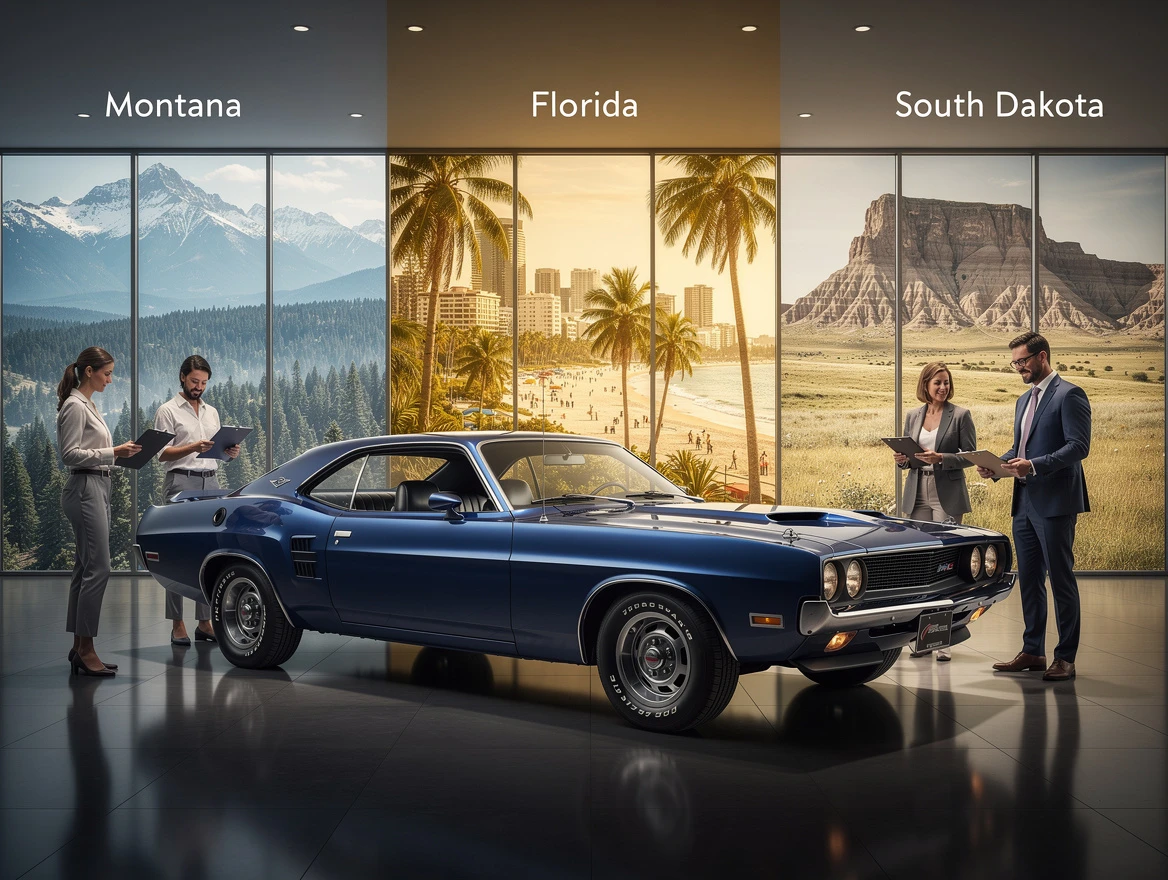
The operational mechanics of establishing title and registration determine how much personal time and administrative effort you must invest. Selecting the best state to register a collector car: Montana vs. Florida vs. South Dakota requires understanding the documentation workflows for each jurisdiction.
The comparative matrix below outlines key operational differences across all three states:
| Feature / Requirement | Montana | Florida | South Dakota |
|---|---|---|---|
| State Sales / Excise Tax | 0% | 6.0% - 7.5% | 4.0% |
| Non-Resident Ownership Path | Montana LLC formation | Physical FL address required | Direct non-resident filing |
| Annual Plate Renewals | Permanent option (11+ yrs) | Annual renewal required | Annual renewal required |
| Mandatory Emissions Testing | None | None | None |
| Initial VIN Verification | Rarely needed on clean title | Mandatory for out-of-state | Not required on clean title |
| Asset Liability Protection | High (LLC ownership shield) | Low (individual title standard) | Low (individual title standard) |
How to Register Imported Car in Montana Compliantly
International classic imports, such as Japanese domestic market icons or vintage European sports cars older than twenty-five years, are exceptionally popular among modern collectors. Titling imported vehicles at local county clerk offices is notoriously difficult because local clerks are unfamiliar with foreign customs paperwork.
Learning how to register imported car in Montana involves pairing your federal customs documentation, specifically stamped U.S. Customs and Border Protection Form 7501, Department of Transportation Form HS-7, and Environmental Protection Agency Form 3520-1, with your Montana LLC paperwork. The Montana Motor Vehicle Division processes federal import paperwork efficiently, issuing a standard Montana title that transforms an imported asset into an easily tradeable, domestically titled vehicle.
If you own unique machinery that crosses the boundary between off-road builds and street machinery, our team also provides street-legal registration and title support for two-wheel collections, dual-sport machines, and elevated powersport builds.
Asset Protection and Forming a Holding Legal Entity
Beyond tax efficiency, high-value vehicle collectors must think critically about personal liability. When a vehicle is titled in your individual personal name, any catastrophic road incident or premise liability issue can expose your broader real estate, investment portfolio, and personal wealth to legal exposure.
Titling your vehicle inside a Montana LLC creates an effective liability firewall. The limited liability company serves as the owner of the asset. In our dedicated guide exploring Montana Exotic Car Registration: No Sales Tax, Simplified Process for High-Value Vehicles, we detail how collectors shelter multimillion-dollar fleets within segregated corporate structures.
For collectors with diverse holdings, pairing classic cars with two-wheel museum pieces, an end-to-end concierge structure simplifies ownership. Look at our dedicated resources for Extraordinary Vehicles to find how multi-asset collections are structured under a single corporate umbrella.
Out-of-State Driving Rules and Multi-State Collector Storage
A critical consideration for any out-of-state registration is understanding state driving laws where the vehicle is physically maintained. States maintain distinct statutory frameworks governing how long an out-of-state vehicle may operate within their borders before requiring local registration.
Most states enforce statutes requiring vehicles driven primarily by residents on public roads for daily commuting to be registered locally within thirty to sixty days. However, collector cars, show vehicles, and seasonal weekend runners are treated differently under many state codes, especially when maintained in private climate-controlled garages, trailered to national concourse events, or driven solely for exhibition purposes. You can read broader guidance in Navigating Vehicle Registration Laws: Requirements & Tips.
To preserve complete compliance, collector owners must observe their home state's use tax statutes. When a vehicle is held inside a Montana LLC, the entity is the owner, but owners should always consult a qualified tax professional regarding the specific use tax rules in their state of primary residence. When you want complete peace of mind, consult Can Someone Handle Vehicle Registration for You? A Concierge Guide for Multi-State, RV, Exotic, and Collector Vehicle Owners to see how white-glove services handle multi-state administrative burdens.
Frequently Asked Questions
How do you register a collector vehicle in Montana from out of state?
To register a collector vehicle in Montana from out of state without relocating, you form a Montana limited liability company. The LLC acts as the resident legal entity that purchases and owns the vehicle. You submit the existing title, bill of sale, and state title application forms through a registered agent in Montana. Once county officials approve the filing, permanent license plates and a Montana title are issued in the name of your Montana LLC.
Can you register a vehicle in Montana without a Montana driver's license?
Yes, you can register a vehicle in Montana without holding a Montana driver's license. When registering through a Montana LLC, the entity is the owner of the vehicle, not you as an individual. Montana statutes require the business entity to maintain an active registered agent with a physical street address within Montana, but LLC members may hold driver's licenses from any U.S. state or territory.
Why do owners register collector vehicles in Montana?
Owners register collector vehicles in Montana primarily to take advantage of zero percent state sales tax and permanent vehicle licensing. On high-value classic cars, exotic sports cars, and rare collection pieces, avoiding a six to ten percent state sales tax saves tens of thousands of dollars upfront. Vehicles older than eleven years are eligible for permanent plates, eliminating all future annual renewal paperwork and recurring sticker fees.
Can you register a vehicle in Montana without living there?
Yes, non-residents can register vehicles in Montana without establishing personal residency. By establishing a Montana limited liability company with an in-state registered agent, the newly formed entity fulfills all statutory residency requirements for motor vehicle ownership. The LLC maintains standing to hold titles, register motor vehicles, and obtain Montana plates completely remotely without the owner ever traveling to the state.
What do you need to register a collector vehicle in Florida?
To register a collector vehicle in Florida, you must provide proof of Florida domicile or a physical in-state address, an original out-of-state vehicle title, proof of Florida auto insurance, and payment for state sales tax and county surtaxes. Florida also requires a certified physical VIN inspection conducted by a law enforcement officer or licensed motor vehicle dealer for vehicles previously titled outside Florida before issuing antique or standard plates.
How do you start a Montana LLC for a collector vehicle?
Starting a Montana LLC for a collector vehicle involves choosing an available company name and filing Articles of Organization with the Montana Secretary of State. You must appoint a registered agent with a physical Montana address to accept service and state notices. Once the Secretary of State approves the LLC formation, you obtain an Employer Identification Number and draft an operating agreement, enabling the LLC to hold title and register assets.
Does South Dakota offer permanent registration for classic cars?
No, South Dakota does not offer permanent, one-time registration for collector vehicles. While South Dakota welcomes non-resident registration and assesses no emissions or safety inspections, owners must pay an upfront four percent motor vehicle excise tax upon titling. Additionally, vehicle owners must pay annual registration renewal fees every year to maintain active license plate status.
Start Your Bespoke Registration →
Determining the ideal jurisdiction for your automotive fleet requires weighing acquisition costs, recurring administrative demands, and asset protection goals. For most collectors holding vintage or high-value machinery, Montana provides an unbeatable combination of zero sales tax, permanent registration options, and entity liability security. When you are ready to expand your collection with effortless precision, start your registration with our concierge specialists and enjoy seamless ownership nationwide.
This is not legal or financial advice. Please consult your CPA/Attorney for all legal and financial guidance. Ride Legal is a privately owned website and is not operated by any government agency.