
The Most Common Mistakes People Make Titling Custom Vehicles
05/27/2026 · Ride Legal
The most common mistakes people make when titling a custom vehicle come down to three culprits: incorrect submission of the Certificate of Origin, failure to secure a valid Bill of Sale, and incomplete VIN verification documentation. These errors regularly cause extended processing delays, or outright rejection of registration applications by state agencies. Get your paperwork right from the start, and your custom build stays on the road where it belongs.
Documentation Errors Cause 80 Percent of Title Rejections
Updated on September 18, 2026
Incomplete or mismatched documentation is the single biggest reason registration applications fail. When you build a custom vehicle, you need a clean paper trail for every major component used during assembly. No exceptions.
The Bill of Sale Requirements
A Bill of Sale must include the seller's full legal name, the buyer's full legal name, the date of sale, and the specific vehicle identification number or chassis serial number. Many owners get rejected because their documentation is missing a notary seal or original ink signatures, both of which states like California, Texas, and Florida require for specialty vehicles.
Certificate of Origin Discrepancies
If you bought a frame or kit from a manufacturer, you need the original Manufacturer's Certificate of Origin (MCO) in hand. Any alterations or white-out marks on that document make it void, full stop. If the name on the MCO doesn't match your current ID, you'll need to establish a chain of ownership, which typically adds two to four weeks to your processing time.
VIN Verification Issues Frequently Delay Custom Vehicle Registration

State inspectors require a unique, legible Vehicle Identification Number on every custom build. A lot of owners hit a wall here because their DIY frame has no stamped number, which means applying for a state-assigned VIN before anything else moves forward.
Ready to register your vehicle?
Join thousands of vehicle owners who use Ride Legal to handle their registration quickly.
Start Your Bespoke Registration →
The Importance of a Stamped VIN
A handwritten sticker or taped-on label won't fly with inspectors. The VIN must be permanently stamped into the primary frame rail in a spot that's physically accessible during inspection. If your frame came from a donor vehicle, run the existing VIN through a stolen/salvage check first, a red flag there triggers an immediate investigation and can stall your entire application.
Working with State Inspectors
Give yourself an edge by taking clear, high-resolution photos of the VIN location, the engine bay, and the overall vehicle profile before your appointment. If your project is a ground-up build, check out What is required to register a modified vehicle with the DMV, it covers the specific lighting and safety standards your build needs to meet.
| Common Mistake | Impact on Processing | Required Action |
|---|---|---|
| Missing Notarization | Automatic rejection | Have all signatures witnessed and notarized |
| Illegible VIN | Delay/Denied inspection | Stamp VIN onto frame with 1/4 inch steel die |
| Incomplete Bill of Sale | Application stall | Obtain missing dates, names, and contact info |
State-Specific Regulations Dictate Registration Success
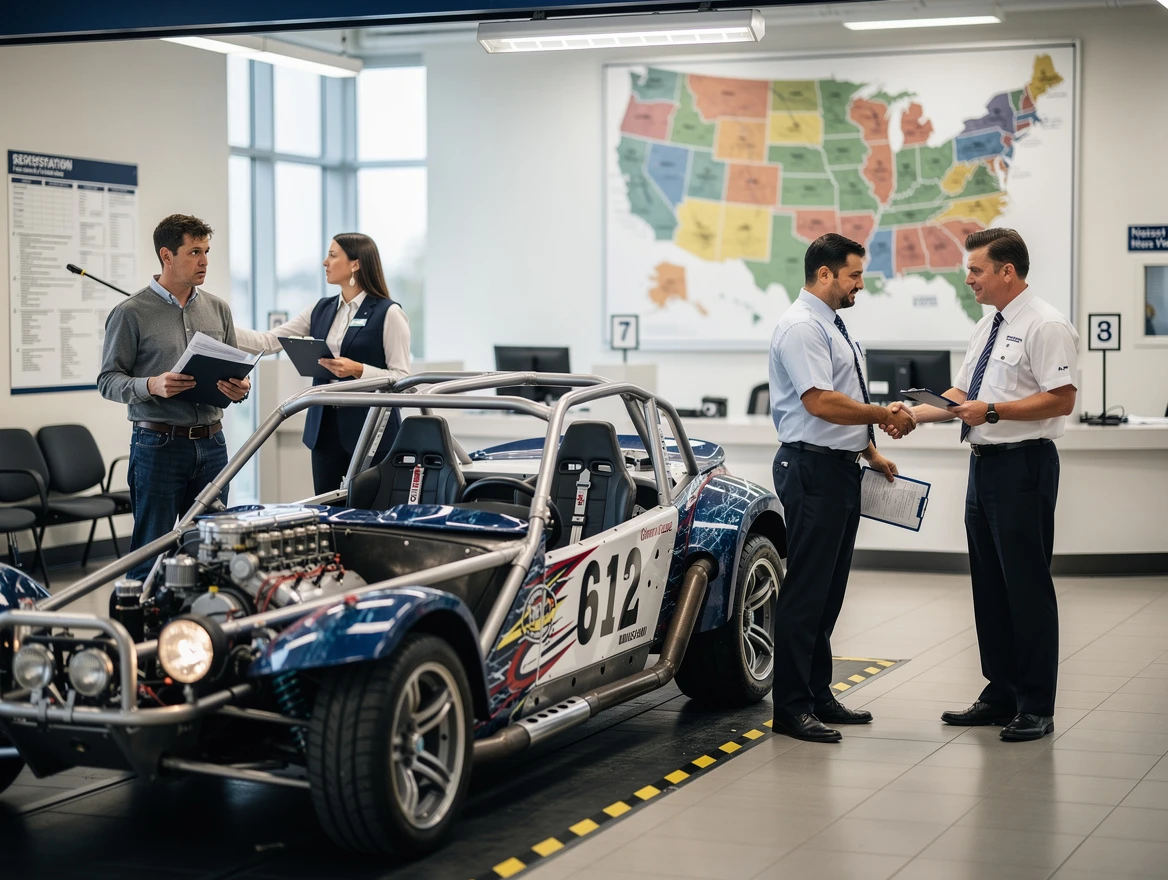
Custom vehicle registration rules shift dramatically from one state to the next, and that gap catches owners off guard, especially when they move or transfer title across state lines. Some states treat custom vehicles as street-legal production cars. Others classify them strictly as off-road use only. Knowing which category your build falls into matters enormously.
Understanding Assembly Definitions
How you define your vehicle, kit car, reconstructed vehicle, or antique modified vehicle, changes the documentation requirements you'll face. For a detailed breakdown, read How can I register an exotic car in another state. That resource explains exactly how residency requirements shape your filing options.
Sales Tax and Valuation
States commonly require a bill of sale that reflects the fair market value of your build. If you can't prove the cost of parts, some jurisdictions, including Arizona and Georgia, will assess the vehicle using current retail market rates, which can produce a surprisingly steep tax bill. Keep a detailed spreadsheet of invoices for every major component: engine, transmission, frame, the works.
See How We Can Help With Your Title Transfers →
Frequently Asked Questions
What should I do if my custom vehicle has no VIN?
If your build has no serial number, contact your local state agency and request a state-assigned VIN application. They'll a physical inspection to verify the components, then issue a new plate to be riveted or stamped onto your frame. Don't try to shortcut this step, it only creates bigger problems later.
How do I replace a missing vehicle title for a custom build?
Replacing a title for a custom vehicle is considerably more involved than it is for a standard car because there's no prior title record to reference. You'll likely need to provide a bonded title affidavit or a detailed statement of facts outlining the full construction history of the vehicle.
Can I register a custom vehicle in Montana if I live elsewhere?
Many collectors use the Montana LLC structure to hold title on their vehicles, it's a well-established and professional way to manage ownership. You can read more about how it works in Montana llc for vehicle registration. The process involves forming a business entity to own the asset, a strategy that high-value collectors use regularly.
Is a Bill of Sale enough to get a title?
In most states, a Bill of Sale alone won't get you a title. You'll generally need supporting documentation, an MCO, receipts for major parts, or a previous registration document, to prove ownership and establish the vehicle's origin. Think of the Bill of Sale as one piece of a larger puzzle.
How long does the titling process take for custom vehicles?
It depends on the state, but most custom builds take between 4 and 12 weeks to process. Because these vehicles don't show up in standard electronic databases, state officials review each application by hand, and that manual process adds time across the board.
Start Your Bespoke Registration Today, No Hidden Fees
Avoiding the most common mistakes people make when titling a custom vehicle starts with meticulous documentation. Secure your MCO, stamp your VIN properly, and keep a complete ledger of part expenses, do those three things, and you clear most of the hurdles state registration throws at you. For anyone managing high-value collections or one-of-a-kind builds, the team at Ride Legal has the hands-on expertise to cut through the paperwork and get you to the finish line.
This is not legal or financial advice. Please consult your CPA/Attorney for all legal and financial guidance. Ride Legal is a privately owned website and is not operated by any government agency.