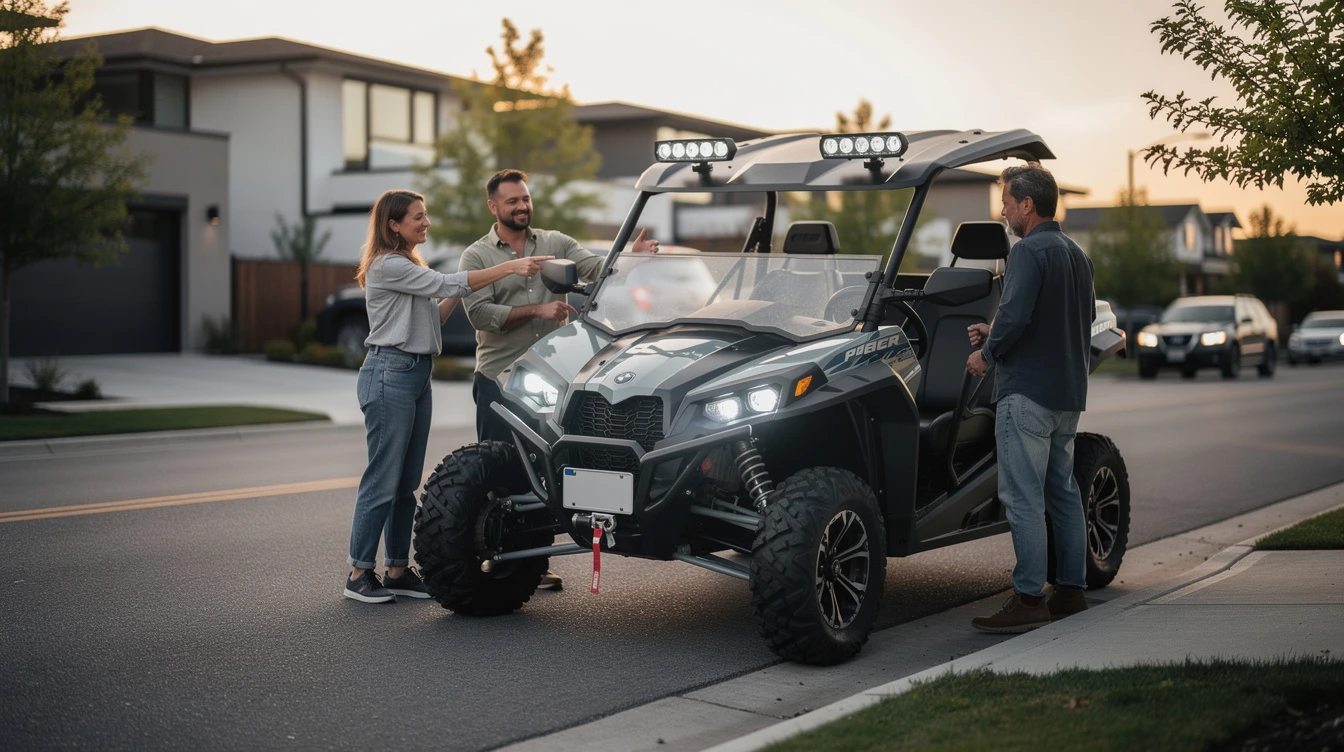
How to Make a UTV Street Legal in 2026: Efficient Guide
05/21/2026 · Ride Legal
To make a UTV street-legal in 2026, you must equip the machine with mandatory road hardware such as DOT-approved tires, mirrors, turn signals, and a lighted license plate bracket, followed by securing an on-road title and plate through a cooperative jurisdiction. Most owners bypass restrictive local rules by setting up a Montana LLC or using South Dakota nonresident paperwork support to acquire highway-ready tags. This multi-step process turns an off-road utility task vehicle into a compliant street machine capable of public road travel nationwide.
Achieving on-road status requires balancing physical vehicle modifications with bureaucratic compliance. Off-road vehicles lack standard passenger car safety items from the factory, which means state motor vehicle codes demand specific mechanical upgrades before any plate is issued. In this guide, you will learn the exact mechanical components required, jurisdictional filing options, state reciprocity mechanics, and how our Concierge paperwork support helps you bypass traditional friction.
Start Your Bespoke Registration →
Acquiring Street-Legal Status Requires Specific Hardware and Out-of-State Titling
Updated on September 23, 2026
Transforming your side-by-side into a road-going machine starts with understanding motor vehicle classification codes. Factory side-by-sides arrive with an off-highway vehicle designation printed directly on the Manufacturer Certificate of Origin, which restricts travel to public trails, private land, and unpaved recreational routes. Bridging the gap to public asphalt demands fulfilling two separate pillars: physical mechanical safety and governmental registration compliance.
You must address the physical prerequisites first. Highway safety standards mandate safety gear that alerts surrounding motorists to your movements, protects passengers, and complies with federal illumination rules. Once the machine possesses the required road gear, you transition to the documentary phase, converting an off-road certificate into an unrestricted on-road title and license plate.
Mandatory Lighting and Electrical Upgrades for On-Road Use
Off-road headlights and generic taillights rarely satisfy public highway lighting codes. Your side-by-side requires high and low beam headlights that project adequate road illumination without blinding oncoming traffic, coupled with bright red taillights, illuminated brake signals, and an amber turn signal kit. These lights must combine into your electrical use with an interior dash indicator and an audible horn rated at a minimum decibel output heard from two hundred feet away.
A lighted license plate bracket is equally critical. Police officers must verify your plate numbers in low-visibility environments, so running an unlit plate invites unwanted roadside stops. For detailed equipment guidelines, review this breakdown of Parts And Equipment to verify that your lighting modules satisfy DOT requirements.
Rearview Mirrors and Visibility Equipment
Visibility remains your primary defense against larger passenger vehicles when riding on blacktop. Motor vehicle codes generally mandate at least two functional mirrors, consisting of an adjustable center rearview mirror paired with a driver-side exterior mirror, though adding both side mirrors provides superior spatial awareness. Convex wide-angle mirrors help eliminate blind spots caused by roll cages and cargo beds.
Depending on your state of operation, you will also need a shatterproof windshield made of DOT-compliant automotive safety glass or polycarbonate. Certain jurisdictions permit safety goggles or helmet face shields in place of a physical windshield, but installing an automotive-grade windshield paired with a manual or electric wiper creates a far more comfortable, weather-resistant driving experience.
DOT-Approved Tires and Mechanical Running Gear
Aggressive off-road mud or rock-crawling tires feature soft rubber compounds that wear out rapidly on hot asphalt and fail to grip wet pavement adequately. Street-compliant operation requires tires carrying the Department of Transportation stamp on the sidewall, confirming they meet federal tread depth, speed rating, and structural integrity guidelines. You must also maintain functional seat belts for every seating position, an emergency parking brake, and an exhaust system equipped with a spark arrestor that meets regional decibel limits.
State Titling Barriers Make Out-of-State Registration the Premier Solution
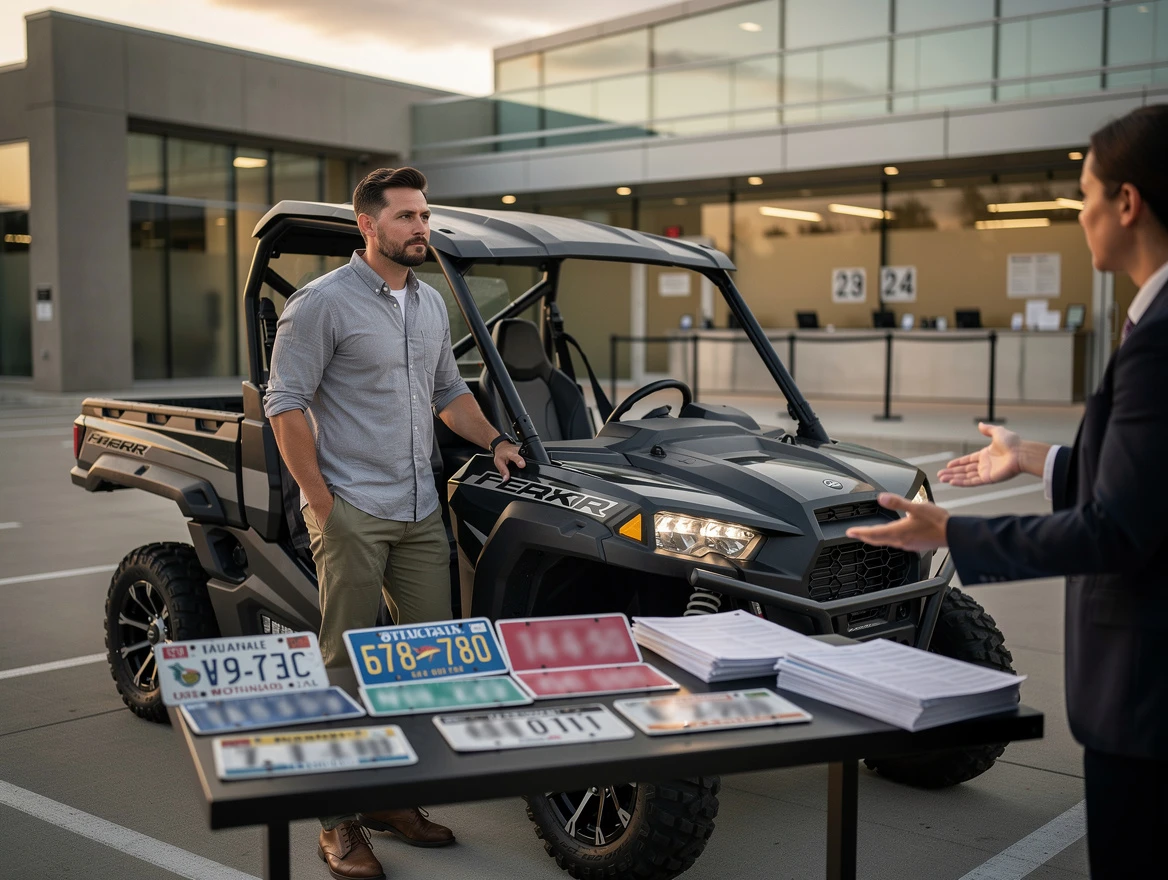
Securing road gear on your machine is only half the battle. If your home state prohibits off-highway conversions, local clerks will outright reject your title application regardless of how many DOT parts you install. Fortunately, modern riders use interstate titling pathways that permit non-residents or business structures to compliantly title powersports equipment in accommodating states.
Ready to register your vehicle?
Join thousands of vehicle owners who use Ride Legal to handle their registration quickly.
Start Your Bespoke Registration →
Understanding out-of-state frameworks protects your capital and time. Jurisdictions like Montana and South Dakota offer structured, accessible programs designed specifically for recreational vehicles, motorcycles, and UTVs. By establishing ownership via a Montana LLC or completing out-of-state individual paperwork, you receive a legitimate road title and metal plate that unlocks public highway travel nationwide under interstate reciprocity agreements.
The Montana LLC Ownership Structure Explained
Forming a Montana limited liability company serves as one of the most efficient avenues to title an elevated side-by-side. Under Montana law, a domestic LLC acts as an independent entity capable of owning assets, including elevated UTVs, quads, and high-performance powersport platforms. Because the corporate entity resides in Montana, its vehicles are titled and registered directly through the Montana Motor Vehicle Division.
Montana levies zero percent general sales tax on vehicle asset purchases, which produces meaningful financial savings when buying bespoke side-by-sides, race-prepped machines, or high-end UTV fleets. We handle the required filings to register assets through your newly formed Montana LLC, eliminating administrative headaches while establishing airtight entity compliance. The entity structure also offers discreet asset separation from your personal estate.
South Dakota Non-Resident Paperwork Pathways
South Dakota represents an alternative avenue for powersport owners looking for a direct individual titling process. Unlike states that demand physical residency or in-state driver licenses, South Dakota permits non-resident owners to title and plate off-road conversions by submitting an out-of-state title application, proof of ownership, and an affidavit verifying installed road-safety equipment.
The state assesses a low, flat excise tax on the vehicle purchase price, making it an attractive option for owners seeking simplified individual registration. Working with private registration specialists helps make sure your vehicle identification numbers, invoices, and safety declarations match exact county treasurer guidelines on the initial submission.
Overcoming Home-State Conversion Roadblocks
Many regional authorities maintain rigid statutes that flatly ban converting off-road vehicles into road-going machines. In places like California or New Jersey, state administrative codes forbid the DMV from converting a vehicle identification number tagged with an off-highway classification into a passenger road registration. Readers often ask how to work through these regional roadblocks without wasting months on bureaucratic disputes.
A more detailed breakdown is available in Can you have a vehicle registered in a state you don't live in?, which highlights interstate ownership frameworks and administrative rules. By establishing compliant out-of-state registration, you bypass local DMV roadblocks while securing physical plates recognized across state borders.
Comparing Methods: How to Make a UTV Street-Legal in 2026
Choosing the right registration structure depends on your vehicle value, ownership preferences, and state of residence. Review the factual breakdown below to evaluate your options for completing the registration process remotely.
| Registration Route | Best For | Sales Tax Impact | Inspection Demands | Turnaround Estimate |
|---|---|---|---|---|
| Montana LLC | High-value UTVs, elevated builds, multi-vehicle fleets | 0% state sales tax | Zero physical inspections | Roughly 3 to 5 weeks |
| South Dakota Non-Resident | Individual owners, mid-range machines, direct titling | Low flat excise tax | Self-certified safety affidavit | Roughly 2 to 4 weeks |
| Home State Local DMV | States with permissive UTV conversion statutes | Standard local sales tax | Rigid in-person state patrol inspection | Varies widely by county |
Riders often wonder if operating an out-of-state plate creates administrative exposure when hauling or riding across state lines. A helpful perspective on interstate plate travel is explored in This is why we see so many damn Montana plates in San Diego, showing how vehicle collectors and enthusiast riders maintain compliant out-of-state registrations year-round.
Look at VIP Ownership Solutions →
Navigating Insurance, Interstate Reciprocity, and Road Rules
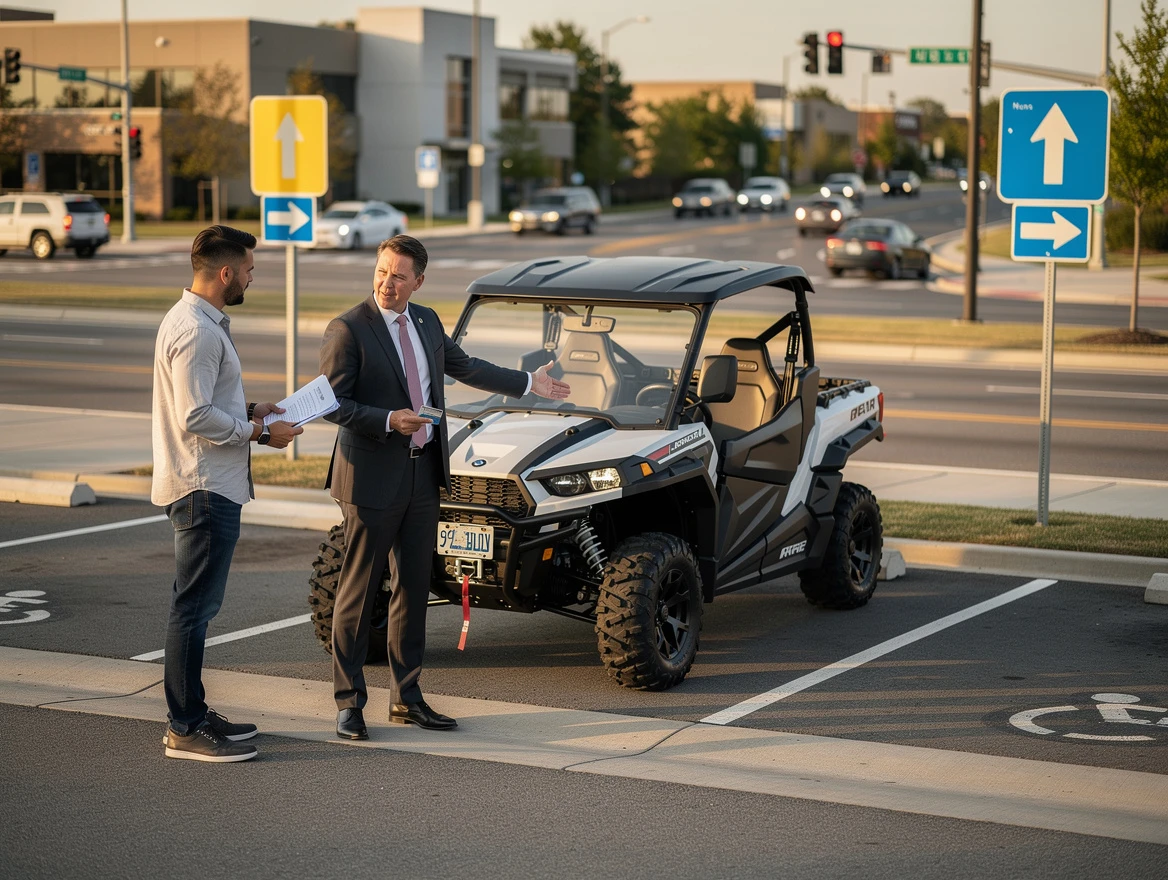
Holding a metal license plate and an on-road title is a major milestone, but safe road operation requires satisfying insurance and highway standards. Public roads introduce unique liabilities that basic off-road trail policies do not cover. You must align your policy with on-road vehicular requirements before turning the ignition on paved roads.
Operating a street-modified side-by-side also means respecting regional road class restrictions. Certain states grant access to secondary roads, county routes, and urban streets, while prohibiting off-highway vehicle platforms from driving on limited-access interstate highways. Knowing the operational boundaries ensures your riding experience remains seamless and enjoyable.
Securing On-Road Powersport Insurance
Standard trail insurance policies generally exclude coverage the moment your tires touch municipal asphalt. To operate compliantly, you must secure an on-road motorcycle or specialty powersports insurance policy that incorporates bodily injury liability, property damage liability, complete coverage, and collision protection. You must notify your insurance provider that the machine holds a valid street registration and an unrestricted title.
Underwriters familiar with elevated powersports can properly insure custom suspension systems, aftermarket turbos, communication gear, and specialized roll cages. For additional perspective on matching vehicle insurance to registration structures, review Your Exotic Car's Insurance Is Only as Strong as Its Registration to verify that your insurer covers assets owned by business entities or registered out of state.
Understanding Driver License and Age Requirements
Piloting a street-registered utility vehicle on public roads demands a valid motor vehicle operator license. You cannot send unlicensed family members or youth riders onto public routes, even if they possess extensive trail riding experience. The vehicle must be operated by a fully licensed driver who meets regional age requirements, carries proof of current insurance, and maintains active registration documents inside the vehicle.
Helmets and eye protection laws also apply based on jurisdiction. While some states excuse adult drivers from helmet mandates if the side-by-side features an automotive cab enclosure or roll cage, wearing an approved helmet remains a smart safety standard. Check regional highway patrol guidelines whenever you trailer your rig into new territories.
Interstate Reciprocity and Municipal Codes
Under the Full Faith and Credit Clause of the United States Constitution, states generally recognize valid vehicle titles, registrations, and license plates issued by other sovereign states. If your machine holds an authentic Montana or South Dakota plate, other states accept that registration document as proof of governmental titling. However, local operational codes always govern moving traffic within municipal lines.
For instance, some local townships restrict side-by-sides from traveling on roadways with posted speed limits exceeding 45 miles per hour, or they bar them completely from high-speed interstate expressways. If you travel to ride areas like Tennessee or the Midwest, studying regional guides like Can You Make a UTV Street Legal in Tennessee? and Wisconsin Street Legal UTV Rules provides valuable clarity on road networks open to your machine.
How Our Concierge Service Manages the Paperwork Process
Working through state motor vehicle paperwork can consume dozens of hours, involve rejected forms, and lead to frustrating delays. When you entrust your registration process to Ride Legal, our registration specialists handle the complex paperwork, state communication, and filing requirements from start to finish. We provide tailored registration assistance services designed for owners who prioritize discretion, efficiency, and accuracy.
We guide you through the process by validating your documentation, reviewing VIN assignments, creating dedicated LLC entities, and filing precise records with state county offices. Our team verifies that every line item satisfies county treasurer guidelines so your metal plate, registration card, and title ship directly to your door.
Streamlined Intake and Vehicle Document Review
Every registration begins with a brief intake where you submit basic ownership paperwork, such as your existing title or Manufacturer Certificate of Origin, alongside a copy of your driver's license. Our team conducts a pre-submission review to confirm there are no lien encumbrances, clerical errors, or unresolved title jumps that could halt the titling process. If your asset requires ownership clarification, we use deep titling experience to resolve underlying title obstacles.
Owners dealing with delayed title paperwork from previous sellers can study Seller Forgot to Sign Title: What to Do to understand how title transfer corrections work. Catching documentation gaps before state submission eliminates weeks of unnecessary delays.
Montana LLC Formation and Tax Advantage Compliance
If you choose the Montana ownership route, we establish a clean, dedicated Montana LLC tailored to hold your recreational powersport assets. This includes drafting Articles of Organization, obtaining registered agent representation, and preparing annual corporate renewals. Because Montana charges zero percent sales tax, the Montana Department of Revenue does not levy vehicle acquisition sales tax on the transaction.
This structure is completely above board, widely utilized by high-end vehicle collectors, and backed by long-standing state statutory law. For collectors expanding their garages, resources like How Do Wealthy People Manage Their Large Exotic Car Collections? shed light on how bespoke holding structures simplify long-term asset management.
Delivery of Your Physical Title and Metal Plates
Once state clerks complete processing, your authentic street-legal title and physical metal license plates are generated. We coordinate courier delivery so your plates and credentials arrive directly at your preferred address. Shipped in as little as 1 day after final state approval, your documents allow you to mount your plate, notify your insurance carrier, and head out on public roads immediately.
If you encounter unexpected local clerical challenges during your ownership journey, our resource on Vehicle Registration Denied: What to Do offers clear insights into resolving state administrative pushback.
Frequently Asked Questions About Making a UTV Street-Legal
Can I make any brand or model of UTV street-legal in 2026?
Nearly all major side-by-side platforms can be converted for street use, including models from Polaris, Can-Am, Yamaha, Honda, and Kawasaki. The critical factor is equipping the machine with required DOT-compliant safety equipment, including headlights, turn signals, mirrors, a horn, and approved tires. Once the mechanical gear is installed, the vehicle must be titled compliantly through a cooperative jurisdiction such as Montana or South Dakota to secure an unrestricted on-road plate.
Do I need to live in Montana or South Dakota to register my UTV there?
No, you do not need physical residency in Montana or South Dakota to take advantage of their vehicle registration structures. In Montana, non-residents form a domestic limited liability company that serves as the owner of the vehicle. In South Dakota, state administrative statutes explicitly allow non-resident individuals to title and register off-road vehicles through county treasurers by mail with our paperwork support.
Are street-legal side-by-sides permitted on interstate highways?
In most jurisdictions, street-legal UTVs are barred from limited-access interstate highways, toll roads, and freeways due to minimum operational speed limits and federal automotive crash test standards. However, they are generally permitted on secondary state highways, county roads, and municipal streets with posted speed limits of 45 mph or lower. Always check local municipal ordinances in your destination area to verify route compliance before riding.
What is the total estimated cost to make a UTV street-legal?
Total costs depend on your starting platform and your chosen administrative pathway. Physical street equipment kits typically run between $400 and $1,500 depending on lighting quality, windshield choice, and whether you require DOT-approved road tires. Professional paperwork and registration assistance services generally range from $800 to $1,800, which covers LLC establishment, state titling charges, county tag fees, and dedicated registered agent support.
How long does the out-of-state UTV registration process take?
The standard turnaround time to receive your metal license plate, registration card, and title ranges from two to five weeks. Timelines depend on county clerk filing backlogs, mail transit, and whether you are establishing a new Montana corporate entity or completing an individual South Dakota transfer. Working with registration specialists helps make sure your forms avoid common processing rejections.
Will my local police department honor out-of-state UTV plates?
Yes, local law enforcement agencies are trained to honor valid, unexpired out-of-state license plates under standard interstate reciprocity frameworks. As long as your plate is mounted with an active illumination lamp, your registration card is current, your driver's license is valid, and you carry proof of road insurance, your operation is compliant on approved roadways.
Start Your Bespoke Registration →
Learning how to make a UTV street-legal in 2026 unlocks incredible freedom, allowing you to ride directly from your home garage to backcountry trail networks without trailering. By installing the necessary safety components and partnering with Ride Legal for Concierge registration support, you bypass tedious DMV hurdles and protect your valuable time. Mount your plate, fire up your machine, and enjoy the open pavement with complete confidence.
This is not legal or financial advice. Please consult your CPA/Attorney for all legal and financial guidance. Ride Legal is a privately owned website and is not operated by any government agency.