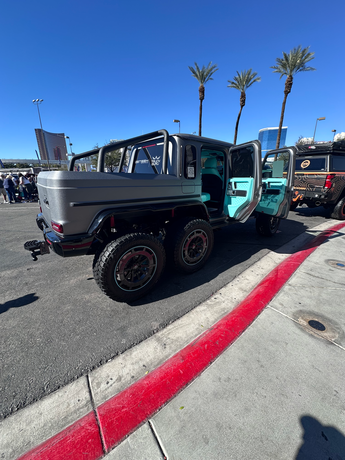
The G Wagon 6x6 is street-legal in most U.S. states when properly registered and equipped, but federal and state requirements determine where and how you can drive it. If your G Wagon 6x6 is manufactured for U.S. market sale, it meets baseline federal emissions and safety standards, making it eligible for standard vehicle registration in your home state.
Spotted at SEMA 2026
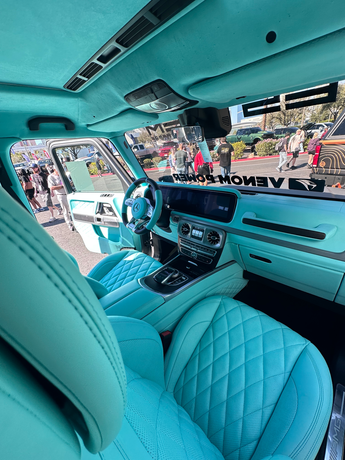
I saw this Mercedes 6x6 in person at SEMA on November 5, 2026, at BOOTH V343 with @venompowertires. Its six-wheel stance made an impression, but the turquoise interior deserved a closer look, with diamond-quilted seats and matching trim across the dashboard, steering wheel, door panels, and headliner.
Check Your Registration Options →
In This Guide
- What Makes a Vehicle Street-Legal Under Federal Law?
- Does the G Wagon 6x6 Meet U.S. Street-Legal Requirements?
- How Do State Registration Rules Affect the G Wagon 6x6?
- What Modifications Make the G Wagon 6x6 Lose Street-Legal Status?
- How Do You Register a G Wagon 6x6 for Street Use?
- Can You Register a G Wagon 6x6 Out of State?
- Frequently Asked Questions
What Makes a Vehicle Street-Legal Under Federal Law?
A street-legal vehicle must comply with federal safety and emissions standards set by the National Highway Traffic Safety Administration (NHTSA) and the Environmental Protection Agency (EPA). These standards apply to all new and used vehicles imported or sold in the United States.
Federal street-legal requirements include:
- VIN and title documentation, proving the vehicle has been registered with the manufacturer or importer
- Safety compliance, including airbags, seat belts, braking systems, and structural integrity
- Emissions compliance, confirmed through a catalytic converter and emissions control system
- Lighting and reflectors, meeting DOT standards for headlights, brake lights, and turn signals
- Compliance labeling, with the manufacturer's label showing federal compliance
The G Wagon 6x6 manufactured for U.S. sale comes with all these built-in, making it eligible for street-legal registration. Imported G Wagon 6x6 vehicles (25+ years old or brought in under specialty importation programs) may have different rules depending on their origin and the state where you want to register them.
Does the G Wagon 6x6 Meet U.S. Street-Legal Requirements?
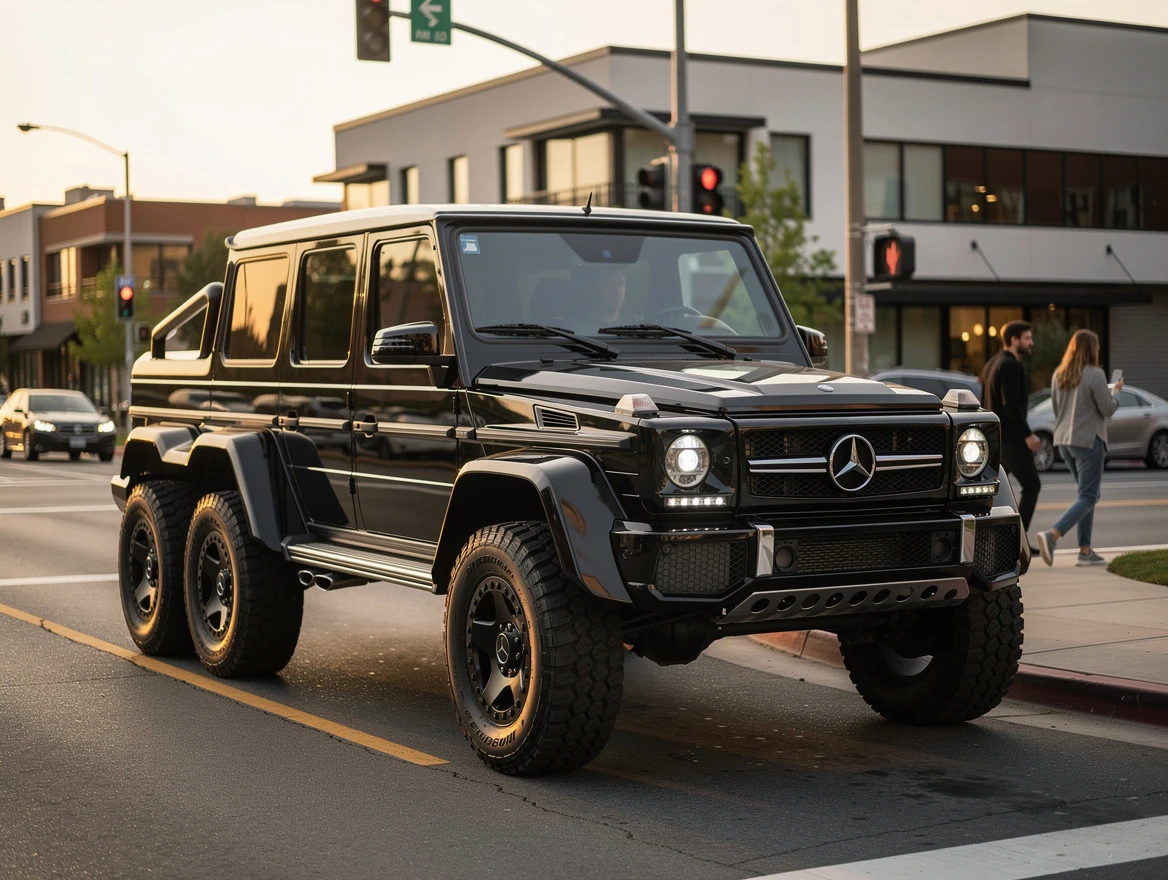
Yes, the Mercedes-Benz G Wagon 6x6 meets all federal street-legal requirements when manufactured for the U.S. market. Mercedes-Benz engineered this vehicle to comply with NHTSA and EPA standards, so it comes street-legal ready from the factory.
Ready to register your vehicle?
Join thousands of vehicle owners who use Ride Legal to handle their registration quickly.
Start Your Bespoke Registration →
Here's what makes the G Wagon 6x6 street-legal:
- Factory compliance labeling confirming federal safety and emissions standards
- Advanced braking system with ABS and dynamic stability control, exceeding federal minimums
- Full lighting package with LED headlights, adaptive lighting, and reflector arrays
- Emissions-certified engine, with a sophisticated catalytic converter and aftertreatment system
- Vehicle Identification Number (VIN) traceable to factory manufacturing records
- Airbag systems and reinforced safety cage architecture
The G Wagon 6x6's elevated ride height, all-terrain suspension, and specialized driveline don't conflict with street-legal status. Height isn't regulated federally, and the 6x6 drivetrain is engineered for both on-road and off-road capability without sacrificing compliance.
How Do State Registration Rules Affect the G Wagon 6x6?
While federal law creates the baseline, individual states enforce their own registration, inspection, and emissions testing rules. Most states treat the G Wagon 6x6 like any other passenger vehicle or SUV, but a few have restrictions on vehicle height, wheel modifications, or emissions.
State-level variations include:
| Category | Standard States | Restricted States | Impact on G Wagon 6x6 |
|---|---|---|---|
| Vehicle Height | No height limit (most states) | CA, NY, MA: height limits 13-14 ft | G Wagon 6x6 is ~7 ft tall, well within all limits |
| Wheel/Tire Size | No federal tire size limits | Some states cap aftermarket wheel modifications | Factory wheels compliant; custom wheels may face scrutiny |
| Emissions Testing | No test (most southern and western states) | CA, NY, NJ, MA, CT: annual emissions testing | Factory emissions system passes all state tests |
| Vehicle Classification | Passenger vehicle or SUV | Some states classify as light truck | Classification affects registration cost only. |
California, New York, and Massachusetts impose the strictest emissions standards. However, the G Wagon 6x6 meets all state-level emissions requirements when unmodified.
For more detail on how vehicle classification affects registration, see Exotic Car Registration Issues and Solutions Explained.
What Modifications Make the G Wagon 6x6 Lose Street-Legal Status?
Modifications themselves don't automatically make the G Wagon 6x6 noncompliant, but certain aftermarket changes can cause it to fail state inspection or violate emissions rules. Understanding which mods are risky keeps you street-legal while customizing.
Modifications that jeopardize street-legal status:
- Aftermarket exhaust systems without EPA certification, which increase emissions and trigger inspection failure
- Engine tuning or ECU programming, especially if it disables emissions controls like DEF systems
- Suspension lifts exceeding state limits, which can affect headlight aim or bumper height regulations
- Wheel and tire combinations that exceed DOT specifications or violate odometer accuracy
- Lighting modifications that alter factory brightness, color, or beam patterns (many states prohibit HID conversions without OEM integration)
- Removing or disabling safety systems, such as airbags or traction control
- Tinted windows darker than state allowance (varies: 35-50% visible light transmission in most states)
Safe modifications that preserve street-legal status:
- Wheel and tire upgrades from OEM suppliers, matching factory diameter
- Suspension components engineered to OEM specifications
- Paint, interior trim, and cosmetic changes
- Aftermarket wheels within DOT specifications and proper load ratings
- Upgraded brakes using factory-compatible components
- Performance upgrades from manufacturer aftermarket programs (Mercedes-AMG options)
If you're modifying a G Wagon 6x6, always check your state's specific emissions and safety rules before committing to parts. Emissions testing in states like California can reject vehicles with unapproved exhaust systems.
How Do You Register a G Wagon 6x6 for Street Use?
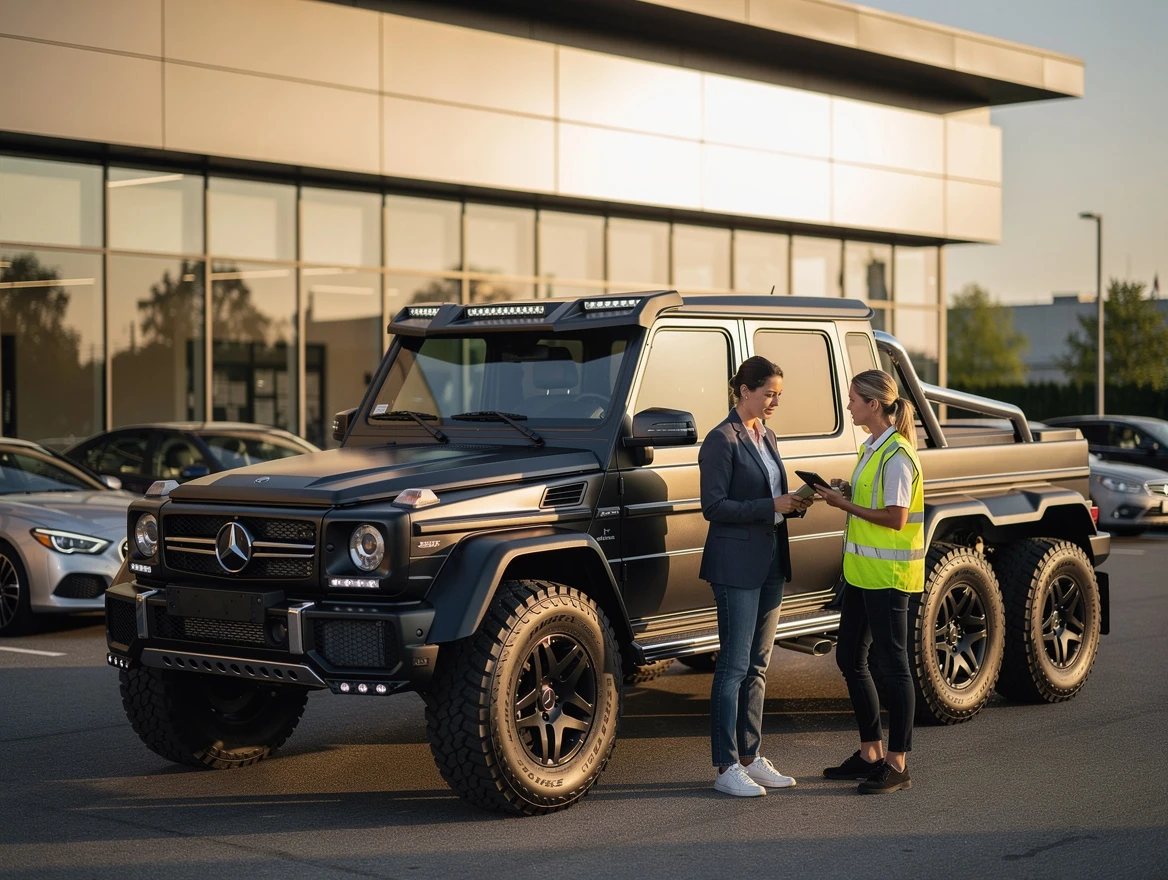
Registering a G Wagon 6x6 follows the standard vehicle registration process in your state. You'll need proof of ownership, a VIN verification, and in some states, an emissions inspection or safety inspection. The process typically takes 1-4 weeks depending on your state's processing time.
Steps to register your G Wagon 6x6:
- Gather documentation: manufacturer's certificate of origin (MCO), bill of sale, proof of insurance, and photo ID
- Verify the VIN through your state's motor vehicle office or an authorized inspection station
- Complete an application for title and registration (your state's form varies; check the motor vehicle department website)
- Pass emissions or safety inspection (required in some states; most G Wagon 6x6s pass without issue)
- Pay registration fees (amounts vary by state and the vehicle's assessed value)
- Receive your title and plates, typically within 1-4 weeks of submission
For G Wagon 6x6 owners in high-value asset situations, alternative registration strategies can offer benefits. See Montana Exotic Car Registration: No Sales Tax, Simplified Process for High-Value Vehicles for options that may reduce your overall ownership costs.
Can You Register a G Wagon 6x6 Out of State?
Yes, you can register a G Wagon 6x6 in a state other than where you live, but the vehicle must be street-legal in that state, and you need a valid business reason or residency claim in that state. This strategy is popular among collectors and enthusiasts managing high-value vehicles.
Out-of-state registration options for the G Wagon 6x6:
- Montana registration, which offers no state sales tax on vehicles and simplified registration for out-of-state owners who form a Montana LLC. Montana doesn't require emissions testing or state safety inspections, and you can manage the entire process remotely.
- South Dakota registration, which has low registration fees and simple residency requirements. South Dakota doesn't impose state sales tax either.
- Home state registration, where you reside, which is the requirement if you drive the vehicle regularly in that state.
Out-of-state registration is compliant only if you don't register the same vehicle in multiple states simultaneously. Choose one state as your primary registration jurisdiction.
Learn more about how to structure multi-vehicle or high-value ownership in Does anyone register their cars to states they don't live in?
Frequently Asked Questions
How to make a car street-legal?
To make any vehicle street-legal, make sure it has a valid title and VIN, meets federal safety and emissions standards, passes state inspection (if required), carries liability insurance, and is registered with your state's motor vehicle department. For factory vehicles like the G Wagon 6x6, this process is straightforward. For older, modified, or imported vehicles, you may need to pass safety and emissions inspections before registration. Once registered, display your license plates and keep your registration card in the vehicle.
What does a vehicle need to be street-legal?
A street-legal vehicle needs a clear title, valid VIN matching the documentation, federal compliance labeling, working safety systems (airbags, brakes, seat belts), proper lighting (headlights, brake lights, turn signals), emissions control systems, and registration with your state's motor vehicle office. It must also carry liability insurance and have valid license plates displayed. Additionally, it must pass any state-mandated safety or emissions inspections and comply with state-specific equipment rules like windshield wipers and horn volume.
Can a monster truck be street-legal?
Yes, a monster truck can be street-legal if it meets federal and state requirements. Custom or heavily modified trucks must pass safety and emissions inspections, have proper lighting and braking systems, meet height and weight regulations, and be registered. Most street-legal monster trucks stay within federal height limits (around 13-14 feet in restricted states) and are equipped with street-legal tires and emissions-compliant engines. Some states are stricter than others, so verification with your local motor vehicle office before modifications is essential.
What state emissions standards apply to the G Wagon 6x6?
The G Wagon 6x6 manufactured for U.S. sale meets federal EPA emissions standards and passes all state-level emissions testing requirements, including California's strict standards. Most states don't require emissions testing, but California, New York, Massachusetts, Connecticut, New Jersey, and a few others do. The G Wagon 6x6's factory emissions system, which includes a catalytic converter and selective catalytic reduction (SCR) aftertreatment, passes all state inspections without modification.
Does the G Wagon 6x6 need a special registration category?
No, the G Wagon 6x6 registers as a standard passenger vehicle or SUV in all U.S. states. While some states classify heavy-duty trucks separately, the G Wagon 6x6 falls under passenger vehicle classification for registration purposes. A few states may classify it as a light truck, which can affect registration fees but not street-legal status. Check your state's vehicle classification system to confirm, but no special registration type is required.
Are there restrictions on how you can drive a G Wagon 6x6 on the road?
The G Wagon 6x6 can be driven on all public roads where vehicles are permitted, just like any street-legal SUV. However, some private property, toll roads, or restricted routes may have vehicle weight or height restrictions. Federal interstates allow the G Wagon 6x6 without restrictions. Off-road driving in public lands depends on local regulations. Always check local ordinances and road-specific rules (bridges, mountain passes, private roads) before planning your route. Off-road use doesn't affect street-legal registration, but your insurance policy should cover both on-road and off-road use if you plan to use the vehicle that way.
Stay Updated
Get the latest on registration tips, LLC insights, and exclusive offers.
No spam. Unsubscribe anytime.
This is not legal or financial advice. Please consult your CPA/Attorney for all legal and financial guidance. Ride Legal is a privately owned website and is not operated by any government agency.